Last year a founder I know burned four months and eleven thousand dollars on what she called "the developer carousel." Three hires, two agencies, one very expensive database rebuild, and by the end of it she still did not have a deployable application. When she finally told me the full story, the most painful part was not the money. It was that she had never been told what to check before signing anything.
This guide is what I wish someone had handed her on day one. It is written from the other side of the table: I have been the developer in those arrangements on Upwork and Fiverr, I have inherited broken codebases that other people shipped, and I have watched hiring decisions go wrong for reasons that had nothing to do with technical skill. If you are a founder, product owner, or small team trying to hire a full stack developer for a startup in 2026, this is the honest version — including the parts that make developers uncomfortable.
What a full stack developer actually owns
The phrase gets thrown around so loosely that it has almost lost meaning. Some job posts use it to mean "a backend dev who can tweak HTML." Others use it to mean "a small outsourced team of six people." So before you compare candidates, get precise about the job itself.
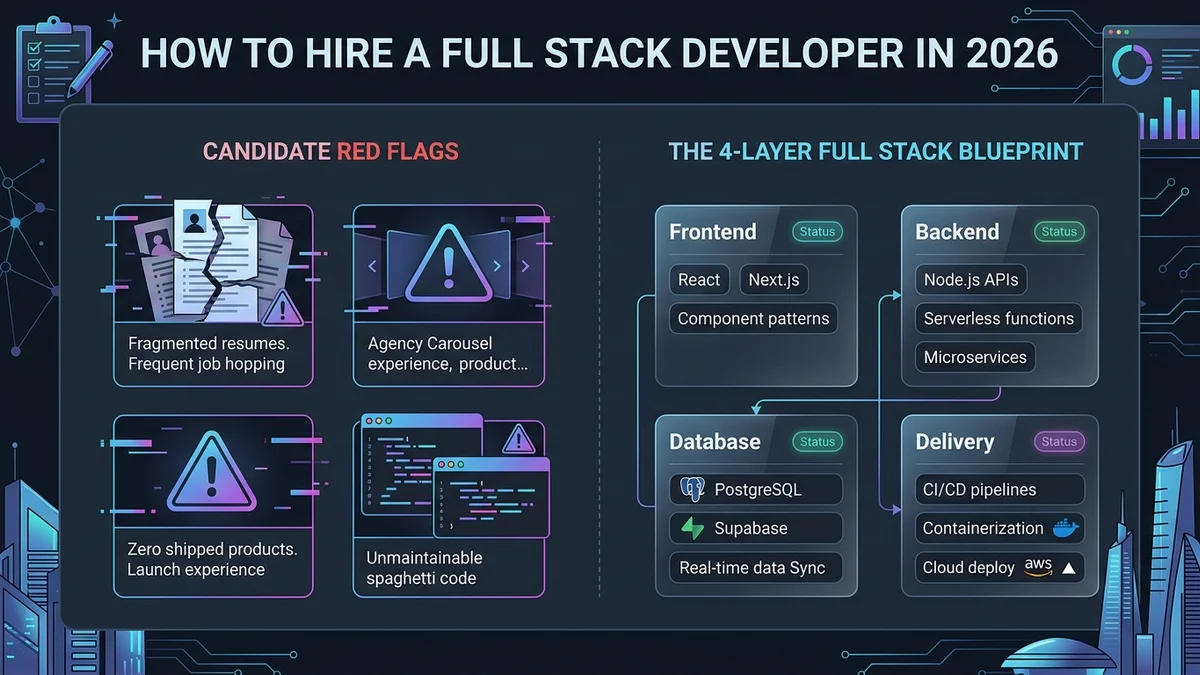
A full stack developer should own the complete path a user takes through your product. That means four layers, and each one fails in a different way:
- Frontend — the React or Next.js interface your users touch. This is not just making it look right; it is state management that survives a refresh, forms that do not lose data when validation fails, and layouts that hold up on a cracked Android phone from 2021.
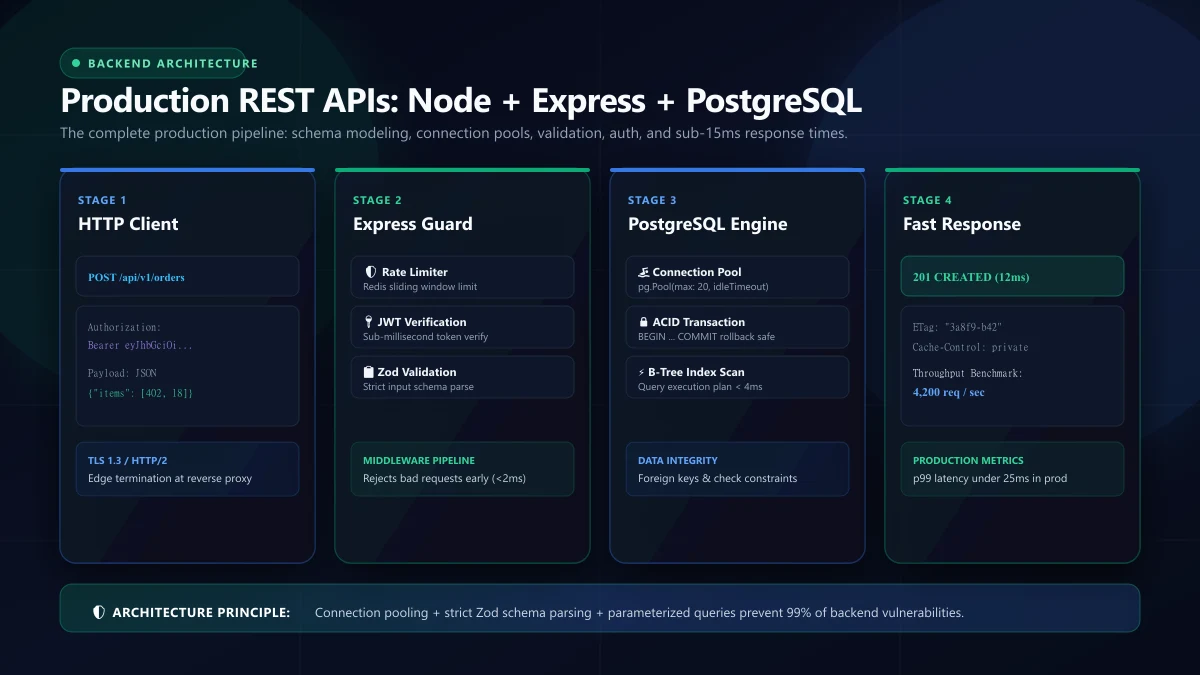
- Backend — the Node.js API layer. Routes, authentication, session handling, third-party integrations like payment providers and email services, and the boring glue code nobody photographs for their portfolio.
- Data — the PostgreSQL or MongoDB schema. This is where amateur work shows up months later as "our reports take forty seconds to load." Schema design is the difference between an application you can extend and one you have to replace.
- Delivery — environments, deployment pipelines, monitoring, and backups. The layer that decides what happens at 2 a.m. when a deploy goes wrong, and whether that event is a minutes-long rollback or a lost weekend.
Here is the practical test I suggest to every founder: ask the candidate to describe an end-to-end flow from a product they shipped — say, a customer completing a purchase. Then keep asking "and after that?" until you reach the point where the customer's data lands in a database, appears in an admin dashboard, and survives a server restart. A person who actually built it can walk that road in detail. A person who worked on fragments will stall at the second "and after that?"
Why one good full stack hire often beats two specialists
Early-stage teams almost always over-hire specialization. It feels rigorous: a frontend engineer, a backend engineer, coordination, clean separation of concerns. In theory that is textbook. In practice, for a product below a few thousand active users, the overhead eats you alive.
I learned this from the delivery side. A fintech client of mine started with two contractors and a coordinator. Every API change took three people and a meeting. The frontend developer was blocked for a week waiting on a backend response to a field rename. Their burn rate was nearly double mine, and their velocity was significantly lower. The problem was never talent — both were competent people. The problem was that their product was not yet complex enough to justify a seam between the two roles.
The economics move in your favor once your boundary conditions get genuinely hard: real-time bidding, low-latency search, intensive report generation, heavy ML pipelines. Until then, one person who understands the whole map makes faster judgment calls with less coordination cost — because everything from the database index to the UI feedback loop lives in one head.
There is one real exception worth naming: if your product absolutely requires native mobile from day one, you need someone whose primary craft is mobile. A web-first developer can stretch to React Native, but "stretch" is doing work in that sentence..Web and mobile are different disciplines with different failure modes, and I would rather tell you that honestly than pretend otherwise.
The tech stack you should expect in 2026
If a candidate today describes their default stack and it does not include TypeScript, probe hard. Not because JavaScript is forbidden — because TypeScript adoption has become a baseline signal. It tells you how a developer thinks about change: whether they expect their own code to be modified later by someone they have never met, and whether they build accordingly.
For web SaaS and business applications, here is the configuration I consider the sensible default right now:
- Language: TypeScript across the entire stack. Shared types between client and server remove an entire class of drift bugs that used to consume schedules.
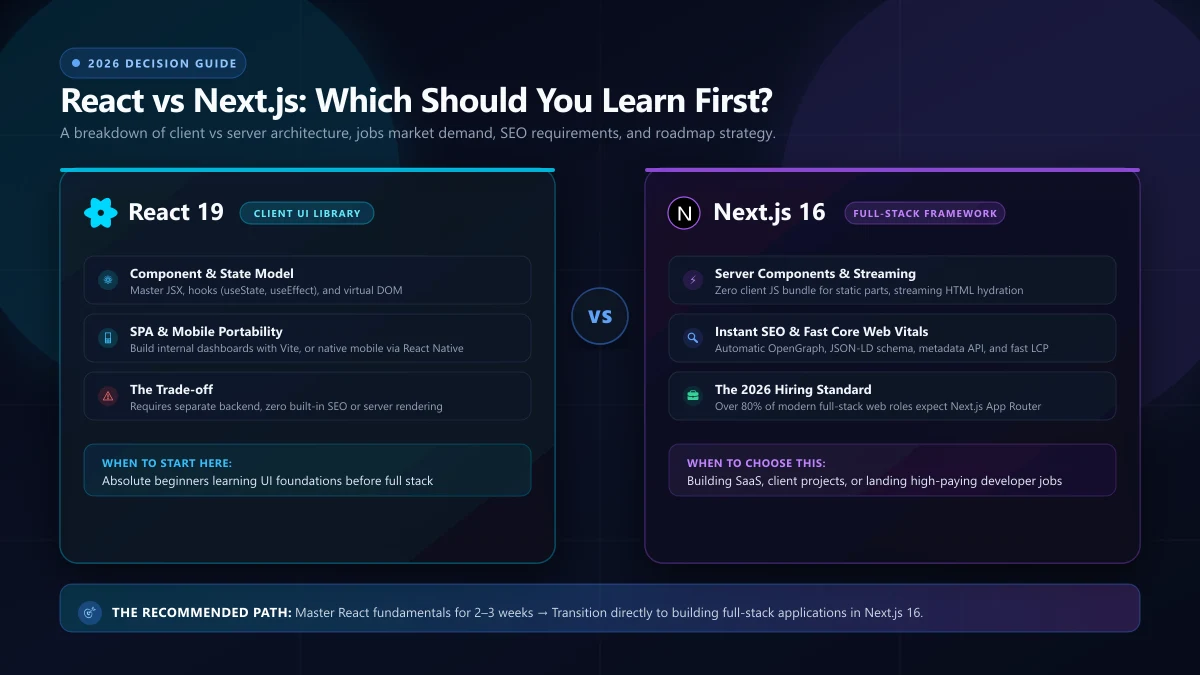
- Frontend: React 19 or Next.js (App Router) for anything customer-facing, since server rendering and SEO come essentially free. A plain Vite SPA is still a legitimate choice for internal dashboards where search does not exist.
- Backend: Node.js with Express or Fastify, or Next.js route handlers for modest API needs. FastAPI when Python-specific AI tooling is on the roadmap.
- Database: PostgreSQL, increasingly via Supabase for early velocity. MongoDB remains legitimate for genuinely document-shaped data, though most teams choosing it do so out of habit rather than data shape.
- Hosting: Vercel for Next.js frontends, Render or Railway for long-running Node services, managed Postgres for the data.
- Workflow: GitHub, small pull requests, CI on every push, previews per branch.
Notice what that list optimizes for: hiring replaceability. Every piece is boring, documented, and widely known. That is a feature, not a compromise. Exotic stacks make recruiting your next developer slower and more expensive, and they turn your first hire into a single point of failure for years.
One stack-adjacent signal that deserves more attention than it gets: ask which AI tools the developer uses and, more importantly, how. Using an assistant to draft a function and then reviewing it line by line is competent modern engineering. Vibe-coding an entire codebase with no tests and no review is how you end up with software nobody — including its author — fully understands. In interviews, I openly walk through my normal workflow: I write the tests first for anything with complex logic, and I treat generated code exactly like contractor code from an unknown freelancer. Review it, understand it, or do not ship it.
Where the good candidates actually are
Freelance marketplaces, used correctly
Upwork and Fiverr get sneered at by people who have never managed their own contract there, but they remain the most efficient way to buy defined engineering work. The trick is filtering correctly. Most bad experiences on marketplaces are purchasing mistakes, not marketplace failures.
What to filter for: repeat clients on a freelancer's profile show up as a pattern in reviews, and a pattern of long-term repeat business is the single strongest predictor I know of a good outcome. topl-level badges help — Top Rated Plus on Upwork, for instance — but badges are earned by delivery metrics, so they merely confirm what the reviews should tell you. What I would weight most heavily, though, is the shape of the work itself: someone who has shipped three complete products for real businesses beats someone with a decade of fragments and no finished whole. Fragmented careers are common on marketplaces, and they hide a specific risk: the person has rarely carried responsibility for a launch.
Also read how they write proposals, not just what they write. A good proposal asks you two or three specific questions about your product. A generic one — "I can do this, I have 10 years experience, message me" — tells you how they will behave the first time something is ambiguous.
Live portfolios: the single best filter
Screenshots can be borrowed. Case studies can be embellished. But a deployed, working application is hard to fake, and it does more screening in ten minutes than an interview does in an hour. The exercise is simple:
- Click around like a normal user. Does the app load fast? Do states feel considered — empty states, error states, loading skeletons?
- Open it on your phone. A 2026 web product that is unusable on mobile is a red flag about standards, not just about one project.
- Break it deliberately. Type nonsense into the date field. Submit the form twice quickly. Blocked APIs offline with devtools. A thoughtful developer has already anticipated some of this and shows friendly feedback instead of a stack trace.
- Ask which parts were hardest. The answer reveals whether they understand their own system.
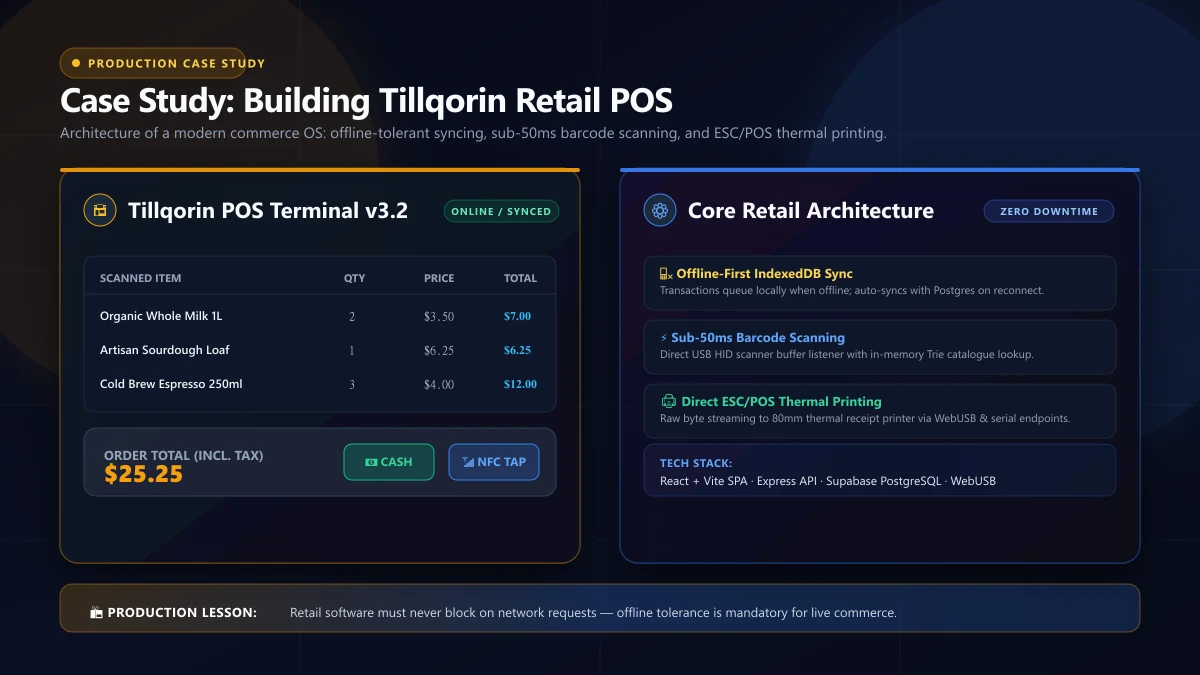
My own portfolio works exactly this way on purpose. Tillqorin POS (a retail commerce platform with real registers firing receipts), AuditBloc (an automated accessibility scanner), and Relay (a privacy-first WebRTC app) all run live at URLs you can hit right now. I would rather a founder poke at my deployed work for ten minutes than read a bullet-point summary of my experience. Live apps are also why I link them everywhere — resume PDFs cannot prove anything except that someone made a PDF.
Communities and your own network
Discord and Slack communities around specific stacks (Supabase, Next.js, indie hacking) surface a specific kind of person: one who answers other people's questions for free, in public, with named tradeoffs. Someone who helps strangers debug for reputation is demonstrably good at explaining technology — and explanation quality is the biggest predictor of a smooth working relationship, because projects die from miscommunication far more often than from hard bugs.
Your own network still punches above its weight too. Ask for a specific kind of referral: not "a great developer" but "someone who shipped a complete product solo for someone like me." Referrals phrased that way avoid the classic trap of inheriting your friend's cousin who "knows React."
How to read a portfolio like an engineer
Founders read portfolios and quietly practice resume awe: lots of logos, lots of frameworks, a wall of benefit-of-the-doubt. Read them instead like a manager assigning risk.
- Completion rate over volume. Three shipped products worth reading deeply beat fifteen half-shown screens. Prefers depth; whole products show judgment about scope, which is the rarest skill in the industry.
- Production deployment evidence. Live URLs, links to app stores, real analytics screenshots — anything dated after launch. Maintenance is a skill of its own, and it only shows on projects that survived contact with real users.
- Writing quality in the case studies themselves. If the developer cannot explain why they chose their architecture in plain language, that gap will resurface as miscommunication the first time your project hits complexity.
- Ownership language versus blame language. "I under-scoped this and we renegotiated" is a green flag. "The client kept changing their mind" in every case study is a pattern worth taking seriously.
Then do one more thing most founders never do: check out the repository, if it is public. You do not need to read code. Look at the commit history story. Small, frequent, describable commits — "fix pagination rounding on invoice list" — signal a methodical builder. One 40,000-line commit called "final version" signals the opposite, no matter what any interview answer claims.
Red flags that actually predict blowups
Skip the clichés like "no degrees." Here are the ones I would treat as load-bearing warnings, because I have watched them detonate real projects:
- No live work in the portfolio. Every screen is an image with "for NDA reasons" next to it. Some of this is real — I have confidential client work I cannot show either — but a portfolio with zero inspectable evidence anywhere is asking you to make a decision on pure authority. There is almost always at least one product that can be shown.
- Answers without questions. You describe an ambitious feature and they say "yes, easy, two weeks" before asking who the users are and what happens when it fails. That reflects someone selling confidence rather than delivering understanding. Real estimates come after questions because real software — that phrase trips people up, but it is true — mostly depends on requirements quality, not typing speed.
- No version control discipline exposed anywhere. If they cannot or will not show any evidence of branching, PRs, or reviews, assume they have never worked on a team and never needed to.
- All-or-nothing pricing. "It will be 40K total, I cannot break it into milestones." Milestones are not just payment protection; they are forcing functions that keep scope honest. A developer who refuses them may be hiding estimation uncertainty large enough to hurt you.
- Zero mention of maintenance or handover. If the plan is feature, feature, feature and there is no mention of documentation, staging environments, or rollback, you are being quoted for a launch — not for a product that anyone can run afterwards.
Interview questions that separate builders from talkers
You do not need to be able to code to run a strong interview. You need questions where the difference between real experience and studied theory becomes audible. These five have worked well for me on both sides of this conversation.
1. "Walk me through the database schema of the last product you shipped." A real builder explains three or four core tables without notes, with actual fields, and — this is the tell — mentions at least one constraint they added after getting burned ("we let negative stock happen once; never again"). A talker says "I used a relational database and normalized it" and stops.
2. "The API returns a 500 halfway through a customer's checkout. What does your code do next?" The right answer is a story about user experience: the customer sees a friendly message, the cart state is not destroyed, the error is logged with a request ID, and an alert reaches someone. A wrong answer — and I hear them — focuses purely on the technical exception handling. The missing dimension is graceful degradation, which is what your users will actually feel.
3. "What part of your last project would you redo today, and why?" Builders love this question, because every shipped product embarrasses its author slightly. You are listening for specific,located criticism: "I should have split orders and shipments from day one." Vague humility ("there is always room to grow") is the sound of someone protecting a facade.
4. "How would you keep the first page load under two and a half seconds?" You want specific tactics: image format choices, parallelization of critical requests, caching, deferring non-critical JavaScript. Buzzword-free specificity is what separates people who have shipped performance budgets from people who have read articles about them.
5. "A bug shows up in production on Friday at 6 p.m. Describe the first thirty minutes." Listen for triage over panic: reproduce, assess blast radius, decide hotfix versus rollback, communicate status. A prepared answer here is the closest thing to evidence you will get about how the worst week of your project will actually go.
Pricing, engagement models, and the contract
Prices vary enormously by region, seniority, and product type, so I will not pretend there is a single honest number. But the structure of a healthy engagement is remarkably stable, and it is the same whether the hourly rate is fifteen dollars or two hundred:
- Hourly for open-ended work where scope will evolve — ongoing product development, maintenance retainers, rescue projects where nobody knows the full extent of the mess yet.
- Fixed-scope milestones for defined builds — an MVP with a clear feature list. Each milestone is demonstrably done, reviewed, and paid before the next one starts. This protects you from disappearing acts, and protects the developer from scope-creep guilt.
- Retainers for steady monthly improvement once the product has real users and real change requests arrive weekly.
Insist that the written agreement covers, at minimum: deliverables per milestone (in testable language, not vibes), revision policy, what happens on delay on both sides, intellectual property transfer at payment (you own the code and credentials, full stop), confidentiality, and the post-delivery support window. None of this is adversarial. Well-written scopes prevent the awkward argument that kills otherwise good relationships — and honestly, they protect developers too.
One founder habit that quietly wrecks these arrangements deserves its own paragraph: verbal scope changes. Every request is small. "Just one more field" appears in meetings, then Slack, then calls, and six weeks later the timeline is unrecognizable and both sides feel robbed. If your developer does not push back on this themselves, do it for them: new requests go into the backlog, get estimated, and re-enter the plan deliberately. Both sides will feel like adults.
Onboarding: getting the first month right
The moment of handoff tells you more about a developer than any interview did, yet it is the phase founders plan for least. A simple, boring month-one structure saves most of the pain:
- Days 1–5: environment setup, repository access, a walk through the architecture together. Yes, live walk-through; documentation alone is never enough.
- Weeks 2–3: one small-but-real feature shipped to production end to end — not a toy task, a genuine slice, because that exercises every layer and every step of the pipeline.
- Week 4: first milestone review. What is slower than expected? What requirement turned out to be wrong? Renegotiate in the open now, while the relationship is still cheap to fix.
And keep a two-way simple rule: you reply within one business day; the developer ships explained progress every couple of days. "Explained" means a sentence about what changed and why — not silence followed by a finished feature. Teams run on that rhythm; it sounds trivial and it is not.
If you only remember five things
Strip out every page above and this is the load-bearing checklist:
- Test live work before you consider anyone. Ten minutes on a deployed app beats an hour of interview theater.
- Demand the boring stack by default — TypeScript everywhere, React/Next.js, Node.js, PostgreSQL. Replaceability is a moat for you, not for them.
- Buy milestones, not grand totals. Scope honesty is a contract feature, not a trust feature.
- You own the code, the domain, the credentials, the data — always, from day one.
- Plan the month after launch, not the launch. Maintenance is where products are actually won.
Frequently asked questions
What does a full stack developer cost in 2026? Depends mostly on region and scope. Marketplaces let you hire across that whole range, so work backwards from the milestone structure, not from a single headline price. If a quote arrives with no milestones attached, treat it as an estimate, not a plan.
Full stack developer or a small dev agency — which is better for an MVP? A strong solo full stack developer is almost always faster and cheaper for a first version, because there is no coordination tax and the same person carries the whole mental model. Agencies start making financial sense when several workstreams must genuinely move in parallel.
How technical does a founder need to be to manage a developer? Barely, if your process is right. You are evaluating evidence — live work, written scopes, explained progress — not git commands. What you do need is clarity about what "done" means for each milestone, because vague definitions of done is how both sides end up angry.
Should I hire before or after I have designs? At least rough designs, yes. Developers estimate against specification, and estimates built on diagrams of paper are guesses with confidence intervals you did not choose. Rough but real Figma beats a paragraph of "you know, something like Airbnb."
What if I already have a half-finished codebase from a previous developer? Then part one of your project is an audit, priced as its own milestone. Paying a few hours to have the codebase assessed — architecture, deployment story, test coverage — is dramatically cheaper than buying a rescue that turns out to be a rebuild.
Need a full stack developer who ships live products you can test before you ever talk to them? Browse deployed projects or start a conversation. I answer within a business day.