Every few weeks someone messages me the same question in a slightly different wrapper: "should I learn React first, or Next.js?" Sometimes it is a student building a roadmap. Sometimes it is a founder about to bet three months of runway on a framework choice. Last month it was a bootcamp instructor who wanted to restructure her whole curriculum around the answer.
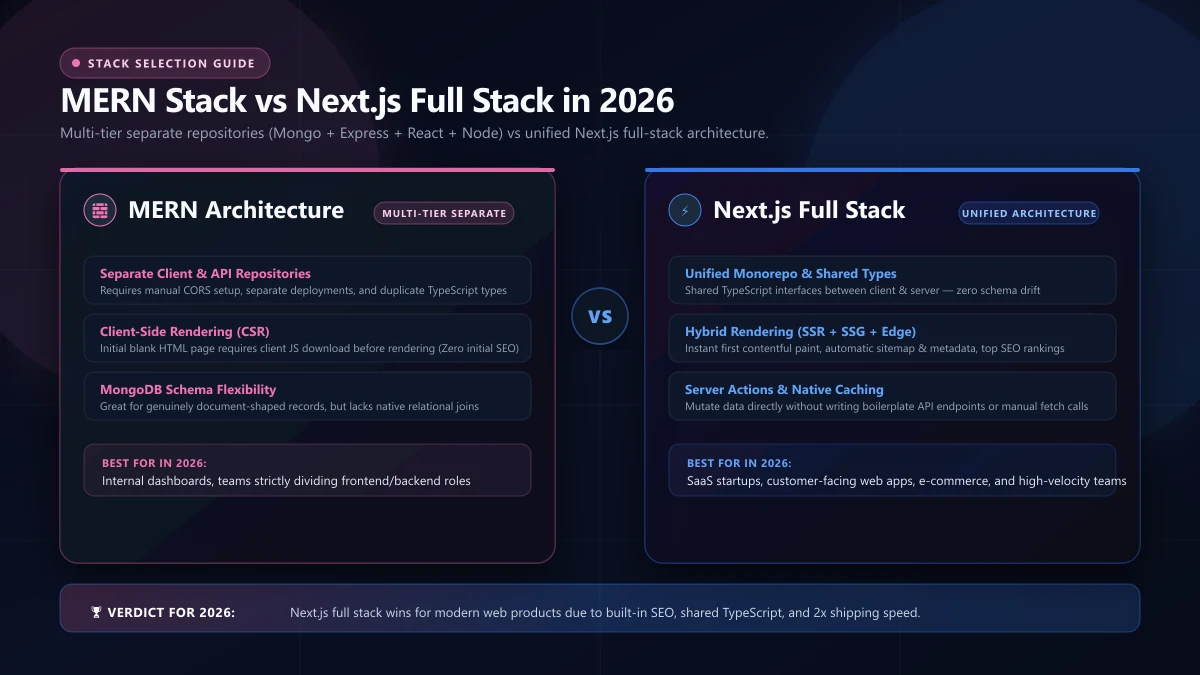
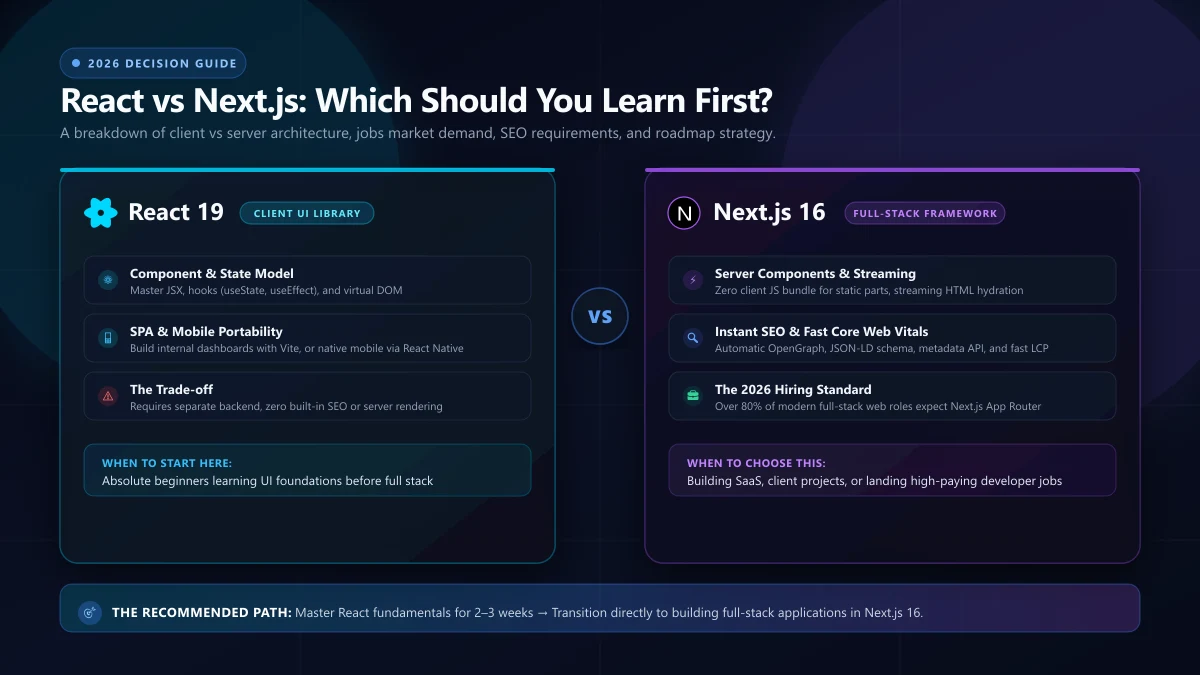
The question contains an assumption that took me a while to notice when I started answering it: most people asking believe React and Next.js are competitors — two doors into the same room. They are not. Next.js is built on React. Choosing Next.js does not avoid React; it commits to React plus a rendering architecture, a router, a caching model, and a set of deployment assumptions. That misunderstanding is behind most of the bad advice online, which usually reads like "Next.js is better in 2026, learn that" — true for some goals, wasteful for others, and near-useless as a roadmap.
So instead of picking a winner, I want to give you the actual decision as I make it when I start a project, plus a learning order that will not waste your first six months.
What changed between 2020 and 2026, in one paragraph
In 2020, a "React project" meant a client-side SPA, usually with Create React App, and most real products needed a photo gallery of workarounds to rank or share properly — server rendering bolted on with Next pages, head-detectors, manual sitemaps, a lot of hope. Then the App Router era arrived, and Next.js stopped being "React with routing glue" and became a full rendering platform: server components, streaming, granular caching, metadata APIs, route handlers. Meanwhile the SPA world moved to Vite and got fast and pleasant — for the jobs it is genuinely good at. The two tools now occupy different rooms rather than sharing one.
The consequence most people still miss: the phrase "should the app be React?" depends entirely on whether anyone needs to find it. That single question resolves the majority of framework debates in thirty seconds.
Learn React fundamentals first — always, no exceptions
I have watched enough developers come up both ways to be blunt about this: you cannot become good at Next.js by skipping React fundamentals. It looks like you can, because templates generate working pages on day one. But the moment anything breaks, you are debugging two frameworks' worth of machinery with the vocabulary of neither.
These fundamentals carry all the weight later:
- Components and props — the composition model everything else builds on. If you cannot explain why a component re-renders, you cannot explain hydration mismatches either.
- State, effects, and the render cycle —
useState,useEffect,useMemo, and especially the mental model of when functions re-run and why. In a server-component world this becomes the vocabulary for the client/server split. - Data flow downward, events upward — prop drilling, lifting state, context. Every real bug ticket I have ever triaged in a React codebase reduces to someone breaking this flow.
- Lists, keys, and controlled inputs — the everyday craft. Unglamorous, load-bearing.
Give this phase four to eight weeks of daily practice with real builds — a note app with auth against a real API, a dashboard with filters. Not tutorials. Tutorials end where fluency begins, which is exactly why people finish tutorials and feel like they learned nothing.
One more argument for fundamentals-first from the market side: every Next.js role on every job board assumes React. The reverse is only partially true. React skills are the currency; Next.js is the exchange rate.
Learn Next.js when someone needs to find, share, or trust your page
The honest framing: React alone builds applications; Next.js builds sites and products that the open internet interacts with. Three capabilities drive it:
Search engines get real HTML
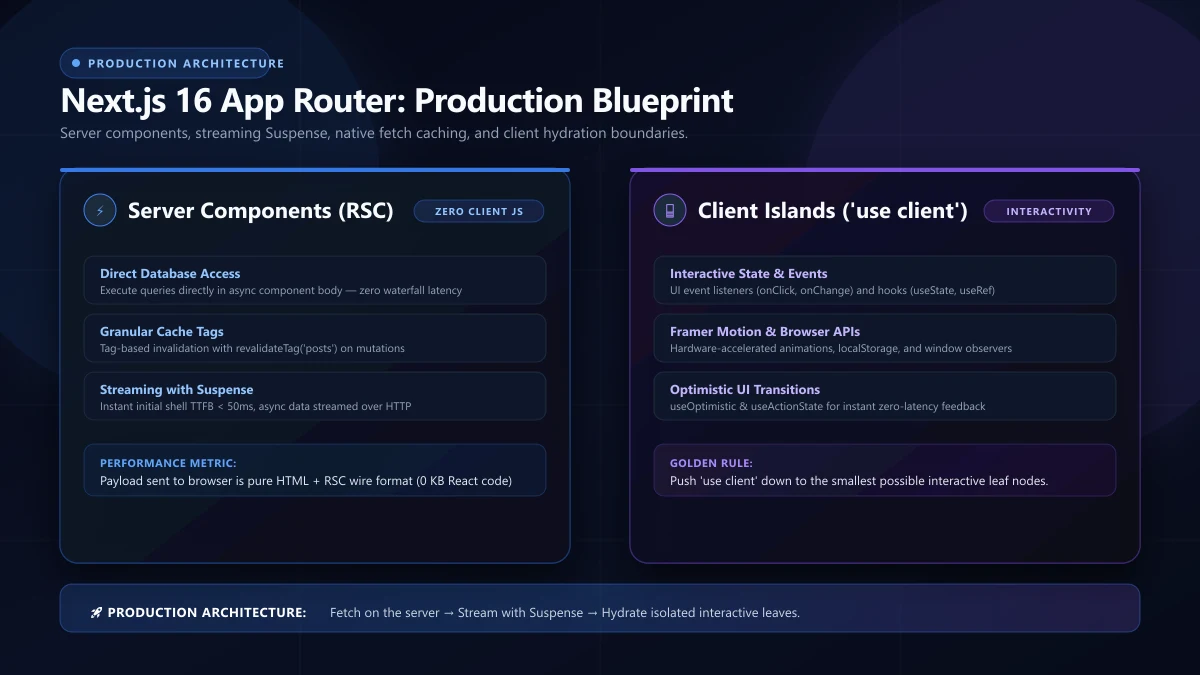
Server components render on the server and ship complete HTML. For anything hoping to be discovered — a marketing site, a blog, a product catalog, a restaurant that wants its menu indexed — this is the difference between ranking and hoping. You can bolt SSR onto a Vite SPA with effort and edge cases, but with Next.js the setup, the metadata API, and the sitemap generation are the path of least resistance rather than the fight.
I felt this personally when I rebuilt my portfolio: the pure-SPA version I had years ago crawled poorly, took flat ages on mid-range phones, and produced link previews I was embarrassed to post on LinkedIn. The App Router version — the one you are reading now — renders server-side, ships small client payloads, and generates metadata, sitemaps, and structured data as a natural part of building pages rather than as a separate discipline bolted on at the end.
Performance by default, not by heroics
Server-side rendering plus granular caching plus streaming means first paint is fast even for users who never clear their cache and never will. A Vite SPA can be tuned fast, sure — but the ceiling for cold load always includes your whole JavaScript bundle, and budgeting that down for a content-heavy page turns into an obsession with micro-optimizations that Next.js simply does not ask for.
Backend in the same repo, without ceremony
Route handlers and server actions give you API endpoints, webhooks, and form handling without a second deployment. For early products this collapses the "do I need a separate backend?" question entirely. For complex domains — commerce logic, jobs, queues — you will still want a structured Node.js service, and Next.js coexists with that fine. It is not either/or; it is a dial.
The decision, as I actually make it
When I scope a project, the framework talks for two minutes and sounds like this:
| Marketing site, blog, storefront, lead-gen | Next.js, no debate — SEO is the product. |
| SaaS dashboard behind a login | Either. Rendering matters less; I usually pick Next.js anyway so auth pages and billing pages share the same stack as the marketing site. |
| Internal admin tools | React + Vite. Speed of iteration, zero SEO surface. |
| Real-time collaboration app | Either — the WebSocket layer dominates; framework is a shell. My Relay guide goes deep on this side. |
| Learning your first production framework | React fundamentals, then Next.js when the project needs to be found. |
Notice that "= Next.js never" appears nowhere in the table. That is deliberate. Next.js is not a scam; it is just specific. The anti-pattern is using it for the one case where its machinery is all overhead — a fully private tool nobody searches for — and then complaining that it is "too magical." Frameworks are not magical; they are opinionated. You pay for opinions with flexibility, and the payment is only rational when the opinions match your problem.
What interviews actually ask in 2026
I sit on the interviewer side of this regularly now, so here is the honest current shape of the market, split by role:
For React roles, expect fundamentals under pressure: reconciliation, why keys matter beyond the compiler's complaint, controlled versus uncontrolled inputs, memoization and when it is theater, accessibility in component design. What separates passable from good is the ability to reason about renders — who re-renders and why — because every performance issue in React is a re-render issue wearing a costume.
For Next.js roles, the good questions are now architecture questions: when a component must be a client component and what it costs when it is; the caching layers and how content actually becomes fresh again after a database write; streaming's effect on perceived load; and — the one that kills most candidates — how you would structure metadata for a multi-page marketing site without duplicating yourself twelve times. If you can explain when not to use a client component, you are in the top fifth of applicants, because most applicants learned the framework as pages-and-effects and never rebuilt their mental model when the defaults changed.
A learning path, concretely
Here is the roadmap I give people who ask me directly, sized in weeks of evenings-and-weekends effort:
- Weeks 1–4: React fundamentals through small real builds. One state-driven UI, one API-driven UI, one list-heavy UI. Deploy each one, even ugly, even on a free tier.
- Weeks 5–6: TypeScript, immediately. Learn it while your habits are soft; retrofitting types onto a JS codebase teaches you to hate both.
- Weeks 7–9: Next.js App Router basics: routes, layouts, loading states, metadata. Build a blog with a real markdown backend and a working RSS feed.
- Weeks 10–12: One capstone with a database — auth, CRUD, and public pages that SEO actually matters on. A content site or a directory. Not a social network; scope is the lesson too.
- Ongoing: one CS-fundamental habit per week — a small algorithm problem, some networking, some database design. The full strategy I use for that side of the education lives in my DSA article.
Five months, no bootcamp debt, and you have things worth showing in an interview — which matters, because portfolios of deployed work have quietly become the strongest signal in this market, far ahead of certificates nobody verifies.
FAQ
Is React getting replaced by anything in 2026? Not meaningfully for hiring purposes. The component model lives in every serious alternative too; learning React's model transfers to all of them.
Can I skip React and go straight to Next.js? Technically, and I have watched people do it. They are productive for a month and stuck for six. The shortcut costs more than it saves, always.
Which is better for a SaaS dashboard — Vite React or Next.js? Either ships it fine. I default to Next.js purely so the whole product — marketing, docs, billing, app — lives in one framework instead of two worlds stitched at the subdomain.
Do I need Node for a pure React SPA? A static host is enough for the client itself; you will want a server for anything real the app does — auth, data, integrations are all servers under the hood, whatever you call them.
Server components vs SSR — clearing up the naming confusion for learners
Because the two terms get used interchangeably in tutorials and they really should not be, this distinction belongs in any learning roadmap: SSR renders HTML on every request, shipping a full JavaScript app that then hydrates and takes over; server components render on the server during the build or revalidation, ship zero JavaScript for themselves, and never "take over" — the client components around them hydrate instead. In practice the former is a delivery mechanism and the latter is an architecture, and modern Next.js uses both together. The practical consequence a learner should internalize early: with server components, most of your UI produces no client bundle at all, which is why the "when do I need use client?" answer in 2026 is so much more rarely "this page" and so much more often "this button."
The traps I watch new developers fall into
Certain mistakes recur with a regularity that makes them worth naming, because each one costs a distinct kind of week:
- Skeleton-chasing before state-handling. New devs polish hover states before they handle loading and error states. Production quality lives in the four states — empty, loading, error, success — and a candidate who shows all four in an interview reads as production-aware immediately.
- Tutorial dependency. Following five tutorials in a row produces familiarity with tutorial structure, not with your own decisions. I coach a strict alternative: follow one, then build a variant without the guide — the gaps you fill define actual learning, and the project you finish is the one you can discuss.
- Premature state libraries. Reach for useState, context, and lifting state first; a global state library is a solution to a scale problem you can recognize when you have it, not before.
- Ignoring the network tab. Half of all "React bug" reports I have triaged are a data-shape mismatch visible in thirty seconds of inspecting responses. Learning your browser's devtools deeply is a bigger unlock than any additional framework knowledge at this stage.
- Being afraid of server rendering. Many developers assume SSR must be complicated because it was, once. The App Router's abstractions removed most of it; the fear is inherited folklore, and it costs opportunities.
For the founder choosing, not the learner
If you are reading this as a business decision rather than a curriculum question, here is the compressed version my clients get: public-facing product with any acquisition ambition — Next.js on PostgreSQL, and do not spend more than a day deciding. Internal tool with no SEO surface — React SPA is fine, and often simpler to staff. Real-time-heavy experience — the real-time layer drives the architecture, and the framework is a shell around it. And in every case: whoever you hire, ask them which parts of the page run on the server. Their answer's precision tells you everything about which capability you are actually buying.
One more dimension completes this comparison: total cost of ownership. React-first and Next-first stacks differ in where their ongoing costs accrue, and honest budgeting means naming them both.
- Refactoring cost: SPA codebases accumulate UI-state machinery that silently increases maintenance load — global stores fighting server cache truth. Server-first projects push that logic into the server, and UI state shrinks toward what is genuinely UI. On client projects I typically find the SPA version spends roughly a quarter of ongoing effort on cache-versus-state reconciliation work the server-first equivalents do not have at all.
- Dependency surface: both ecosystems draw from npm, but the SPA path habitually acquires routers, query caches, and meta-framework libraries to re-solve problems Next.js ships as defaults. Fewer npm dependencies means fewer supply-chain surfaces — an increasingly board-level topic, in my experience.
- Talent continuity: framework-chasing is real market churn every three years. Anchoring on React fundamentals makes that churn manageable; whichever meta-framework comes next, the team's core skills survive the hop, which is the deepest form of hire-mobility insurance there is.
Read that list and a pattern emerges: the SPA-versus-framework decision is not a syntax preference. It is a bet about where your product's complexity will live and who will maintain it across cycles of churn. Products on the public internet live in the framework column; products that stay private can choose either door without penalty — and the difference shows up year three, not week three.
A closing observation from the hiring side, since this question usually arrives wrapped in career anxiety: the React/Next.js distinction matters far less than candidates fear. Interviewers evaluate reasoning — renders, data flow, state boundaries — and that reasoning transfers across both paths. I hired reluctance on framework names and regretted it; I hired reasoning and it compounded. Opinions framework choices, facts transfer.
One practical habit keeps this decision from going stale: every few weeks, build one small feature twice, once as a plain component and once wired through a route boundary. The side-by-side comparison teaches more than any blog post on the subject, including this one.
Tayyab works in React 19 and Next.js 16 daily in production. See the live portfolio or read how I work.