A client of mine spent most of a year building their product on Firestore, then discovered in month nine that the reporting screen their investors asked for required "just a simple summary of orders by customer." In Firestore, that simple summary meant loading thousands of documents into the client and aggregating in JavaScript, watching the numbers grow worse every month, and eventually paying for a second database to do what a single SQL GROUP BY would have done in one query on day one. The migration took six weeks. The feature had taken two days to spec.
I open with that story because the Supabase vs Firebase debate gets framed as a feature comparison, and features are honestly not where this decision is made. Both platforms have good auth, both have realtime, both have storage, both have generous free tiers. The decision lives underneath those checklists, in the data model itself, and in the economics that follow from it. Here is how I actually advise teams in 2026 — and how the answer changes depending on what your product will ask of its database in month twelve, not month one.
The core difference: documents vs relations
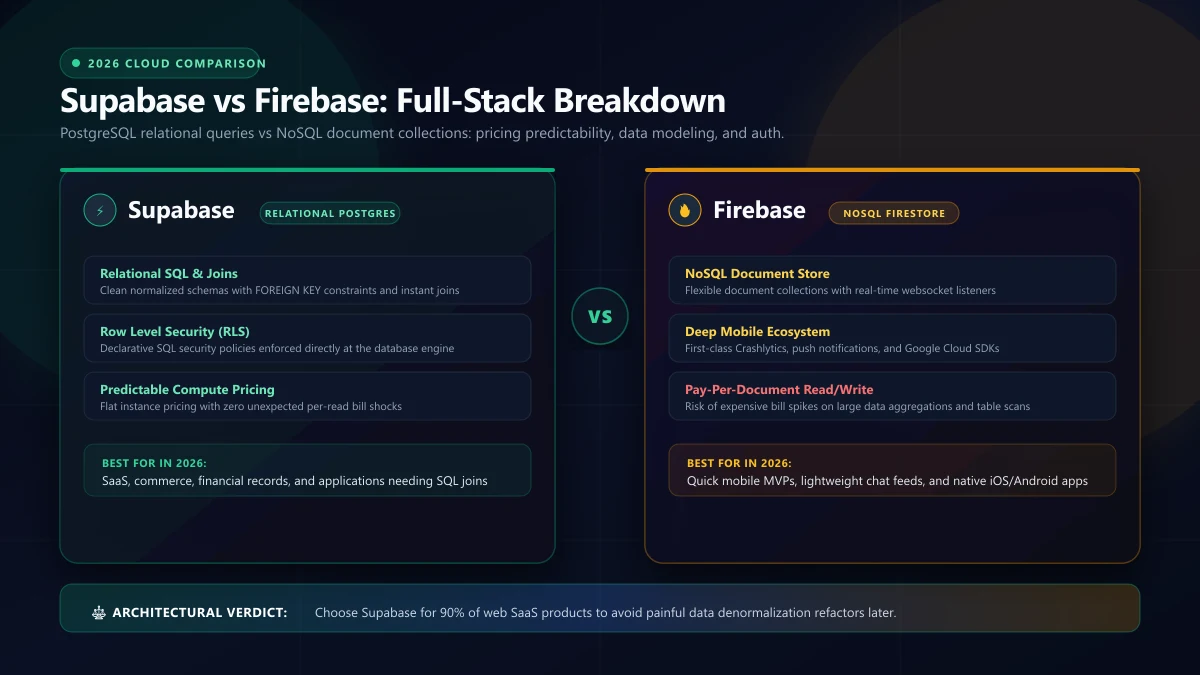
Under the marketing, this is a database-shape argument. Firebase gives you Firestore: documents grouped into collections, queried by filters, reads billed per document touched. Supabase gives you real PostgreSQL — tables, joins, constraints, transactions, views, functions, and full SQL underneath a JavaScript client that happens to feel modern.
Both shapes are legitimate. Neither is "outdated." The question is which shape your data actually has, and the fastest way to find out is to write your product's three most important questions down and look at them:
- If your queries are "get this user's profile," "list recent posts," "fetch this document by ID" — that is document-shaped and Firestore will feel wonderful. Every read is direct, denormalized, and fast.
- If your queries are "orders by customer this quarter, with returns subtracted," "top ten products by margin per store," "accounts whose subscription lapsed but who opened an email this week" — that is relational-shaped, and a document store will push aggregation into your application code where it will grow old badly.
Notice what I am not saying. I am not saying "SQL is more powerful, therefore better." Power you do not use is overhead. I am saying: mock the worst report your product will ever need, write the query for it in both models, and see which onepage of application code it takes. That single exercise settled the debate for every team I have taken through it. For most products with money, inventory, schedules, memberships, or history in them — which is most products —the relational page is shorter.
Feature-by-feature, with 2026 eyes
Authentication
Firebase Auth is mature, polished, and — if you are deep in Google's ecosystem — frictionless. Phone auth, a decade of edge cases fixed, huge community answers. Supabase Auth is genuinely good now: email, OAuth providers, magic links, MFA, and one design decision I value enough to call out: identities are rows in your own database, joined to your data with normal foreign keys. Authorization lands in Row Level Security policies where the data lives, so the classic bug class of "the API layer forgot a check" becomes structurally harder to write.
The honest tradeoff: if phone-auth-heavy onboarding in specific markets is your core flow, Firebase still has the edge in polish. For most SaaS products, either platform's auth stops mattering within weeks — and then the question becomes what auth integrates with, which is the next section.
Realtime
Firebase realtime remains excellent for the canonical chat-shape case: clients listening to a live feed of changes in one narrow dataset. Firestore listeners are battle-tested in consumer apps at enormous scale.
Supabase realtime works differently — Postgres replication channels announcing row changes. It covers most product cases fine (presence, live dashboards, collaborative updates), but chat-scale fan-out with millions of listeners on narrow feeds is genuinely Firebase's home turf. If your product is a live-feed consumer app, weight this heavily. If realtime is a feature — notify me when my order ships — both handle it, and Postgres's version has an architectural virtue worth knowing: the stream is exactly your database's changes, so there is no sync layer to drift out of correctness.
For the heavier real-time cases — peer-to-peer anything, low-latency collaboration — neither BaaS realtime layer is the right tool at all; you reach for WebSockets or WebRTC directly, as I cover in the Relay write-up.
Queries and search
This is where the models genuinely diverge, because it is where documents and relations diverge. Firestore offers indexed single-collection queries and easy per-document fetch, with honest hard edges: cross-collection joins happen client-side, aggregations happen client-side, and full-text search is a bolt-on integration with a third-party service (Algolia or similar) rather than a database feature.
Postgres gives you joins, CTEs, window functions, materialized views, full-text search with ranking and stemming, partial and expression indexes, and now serious vector search. The first time a stakeholder says "can we also see which of these customers had a failed payment attempt," Firestore answers "write a client-side merge function," Postgres answers "here is a join." Multiply that moment by your product's lifetime, and this paragraph is the actual decision.
AI-era needs
In 2026 an increasing share of products store embeddings for search or recommendations. Supabase ships pgvector, so semantic search and RAG-style retrieval live inside your existing database with indexes and SQL filters combined. The Firestore path routes this to external services — workable, but another vendor, another bill, another place where your data model consists of separate shards that your code must keep agreeing with each other.
Pricing shape — the quiet but decisive one
This is the part almost nobody models before choosing, and it is where the migration stories of the last few years mostly begin.
- Firebase bills per operation. Every document read costs a tick. Aggregating a report of 10,000 orders costs 10,000 reads. Feature behavior — showing per-user dashboards, listing histories, computing summaries — converts directly into monthly cost, and that cost scales with your success in ways that surprise finance departments.
- Supabase bills per capacity — compute (and bandwidth/storage) rather than per-read. A report that scans 10,000 rows costs roughly the same compute whether the report covers 100 or 10,000 documents of your own data, because it runs in the database you already pay for. There is a real ceiling at scale (you eventually move compute up a tier), but the bill's shape is predictable, and predictable is what startups need when planning.
Run both pricing models against your product's most read-heavy feature. If reads dominate — a very read-busy consumer feed —Firestore's model can still win. For the mixed read-write-report-heavy SaaS shape, Postgres-capacity pricing usually ends months of anxiety.
Lock-in and exit doors
Firebase is proprietary: your data model, security rules, and client access patterns are Firestore-shaped, and the exit is a rewrite of the data layer. Supabase's backend is Postgres — the most portable server software in history. A pg_dump leaves with schema, data, constraints, and functions intact. Even the "export" argument understates it: skills, tooling, monitoring, community answers, hiring — everything downstream of "it is just Postgres" is easier for the life of the company.
Lock-in matters more than it seems at pick time, ironically because it feels free. The costs arrive exactly when you are growing and every engineering hour is stretched thin — that is when you are asked to migrate, because that is when scale outgrows defaults.
Developer experience, honestly compared
Firebase's SDKs are polished and the ops story is genuinely zero-config; you can ship a prototype astonishingly fast. Supabase's DX has improved sharply — the typed JS client, @supabase/ssr for Next, local CLI dev, edge functions — and its learning curve is real if your team has never worked with SQL, but that learning curve is the transferable kind: SQL and Postgres skills outlive the product, whereas reads-per-billing-tick and security-rule semantics live inside one provider's docs forever.
The decision path, compressed
- Write your five hardest eventual queries. Not the homepage read; the painful, boss-asked-for one. Prototype each in both engines.
- Mock your month-12 bill. Project reads per month per feature under Firebase, versus a compute tier for the same load on Postgres.
- Check your compliance/exit posture. Health data, financial records, anything with export obligations or vendor-risk review: Postgres-portability wins arguments you have not had yet.
- Weigh the team. A team of document-store veterans will ship v1 faster on Firestore; that is a real and fair consideration — just price the follow-on migration you are likely to buy.
Migrating from Firestore to Postgres: the honest version
I have done this, and the good news is that the migration is mechanical even when the data is messy. Order of operations that worked:
- Model first. Export collections to JSON, then design normalized tables from your actual access patterns — not a mirror of the collection structure, which usually carries denormalization scars.
- Load with idempotent scripts, keeping document IDs as UUID keys so references survive.
- Translate security rules into RLS policies. This step sounds scary and usually lands quickly: each rule becomes a policy, and the equivalent guarantees feel stricter than the originals.
- Replace client-side aggregation with views as you ship: every old merge function becomes a view, and the code deleting itself feels like getting paid.
- Parallel-run the read paths behind a flag until numbers reconcile, then cut over.
FAQ
Is Supabase really production-ready at scale? Used across many real businesses; the scaling lever is compute tier plus read replicas plus connection pooling, and the ceiling is high. The honest caveat: enormous consumer-scale fan-out is not its design center — that is where the architecture questions above should steer you elsewhere.
Can I use both? Yes — Supabase as the system of record, Firebase for a narrow capability like push notifications. Keep each single-purpose; the failure mode is two platforms both "owning" the same data.
What about offline-first mobile? Firestore's offline sync is excellent and purpose-built. For Postgres-side offline, you are looking at local-first patterns that other tools solve; if offline is the core product promise, weigh that seriously.
Which is cheaper to learn for a solo founder? Firestore, mildly, at week two. Postgres pays that learning curve back at month four and forever after, because you learned SQL rather than a vendor's query dialect.
Storage, files, and edge functions — the unglamorous checklist
Backend comparisons obsess over the database and skip the workload that actually generates support tickets: files and serverless edges truths. Both platforms handle them differently enough to matter in the decision.
- File storage: Firebase Storage and Supabase Storage both cover uploads, transforms, and signed URLs. The differentiators are access rules: Supabase's derive from the same Postgres RLS policies that govern your tables — one mental model, one place to audit. Firebase's need a second rules file and a second mental model, which is fine — it is just one more surface that knows about your permissions.
- Image transforms: both platforms offer on-transform functionality now; verify the exact transformations (formats, crops, blur placeholders) against your actual UI needs before committing — oversized thumbnails are the classic silent bandwidth tax.
- Edge functions: Supabase Edge Functions (Deno runtime) and Firebase Cloud Functions overlap heavily in 2026 — cron jobs, webhooks, custom auth flows. My practical note: neither replaces a deliberate service layer; both are landing zones for glue code, and the team that keeps glue code in one named place stays saner than the team that spreads it.
- Crons and queues: scheduled jobs exist on both; durable queues with retries are still third-party integrations on either. If your product genuinely needs job processing with backoff semantics, neither BaaS is the finish line — plan for a worker from day one and treat both platforms as the data layer.
None of these decides the architecture on its own. They decide where your second month of surprise bugs lives, which in practice is enough to weigh seriously.
Team topology and hiring, honestly assessed
A decision this foundational outlives the people who make it, so staff the choice:
- Document-store fluency lives with fewer people. The pool of engineers experienced in Firebase-specific optimization (denormalization design, security rules at scale, read-cost management) is smaller than the Postgres talent pool — because Postgres is the academic, commercial, and open-source default everywhere.
- Postgres knowledge compounds. A developer who learns Supabase has learned Postgres, SQL, and RLS — skills portable to every future employer. A developer who learns Firestore has learned Firestore. That difference matters most for early-career teams and matters least for experienced teams who can pick up either in weeks.
- The solo-founder question: speed-to-v1 genuinely favors Firestore if you have never touched SQL; speed-to-v2-with-reports favors Supabase because the reports made not need a second system. Decide which version you are building.
A worked decision — what I would pick today
Given a 2026 SaaS with billing, reporting, permissions, and an AI-assisted search feature, my pick is Supabase + Postgres without much hesitation: the report queries shape the product's economics, pgvector handles the AI feature inside the primary store, and the exit door stays open. Given a consumer companion app whose core is a chat feed with presence and offline sync for two-party messaging, my pick is Firebase, because the realtime layer is exactlyFirestore's design center and every substitution there is friction. The same analysis I ran above, applied honestly to two different products, yields two different answers — which is the point the feature-comparison articles usually miss.
Security posture — where the two platforms quietly diverge
Because both platforms market security as handled, it deserves its own paragraph of honesty. Postgres-with-RLS has one architectural virtue that has survived every audit I have accompanied: the rules live beside the data and apply to every access path — API, console, service role misuse included. The failure mode is exactly what you would then expect: a schema change that forgets a policy is visible in SQL reviews, in policy dumps, and in test suites that probe anonymous reads. Firestore's rules live in their own file with their own language, applying to their own access path — correctly configured, it is solid; the risk concentrates in the age-old pattern of two surfaces claiming the same permissions and gradually disagreeing. Neither is insecure by default; one concentrates its risk in fewer places, which is an operational property worth naming in the decision conversation.
Two security topics deserve first-class placement in either stack's first sprint: secrets in client bundles (any SDK config shipped to a browser is public — design authorization assuming so) and PII lifecycle (export and erase requests arrive eventually, and a document store designed without delete-strategy thought turns that April into archaeology). Neither platform absolves you of either; the product decides.
I build with Postgres and Supabase across my production products — Tillqorin's accounting backend is a worked example. Whether you need architecture advice or hands-on delivery, reach out; the schema conversation is usually where the money gets saved.