Ten years of JavaScript history produced two default answers to "what should the stack be," and almost every team building a web product today quietly picks between them: MERN — MongoDB, Express, React, Node — the free-market veteran that powered the startup decade, and the Next.js full stack, the current default for anything that touches the open internet. The debate is usually conducted as a religion, with each side citing benchmarks at each other. I want to do something more useful: describe when each stack is genuinely the right answer, using the products I have shipped on both sides of the fence as evidence.
Because here is my actual confession up front: I use both, in production, for different jobs. My public-facing web products run Next.js with PostgreSQL; my data-model experiments and several client dashboards ran the MERN configuration happily for years. The framework follows the data and the distribution — a sentence I will defend across this whole article.
First, what we are actually comparing
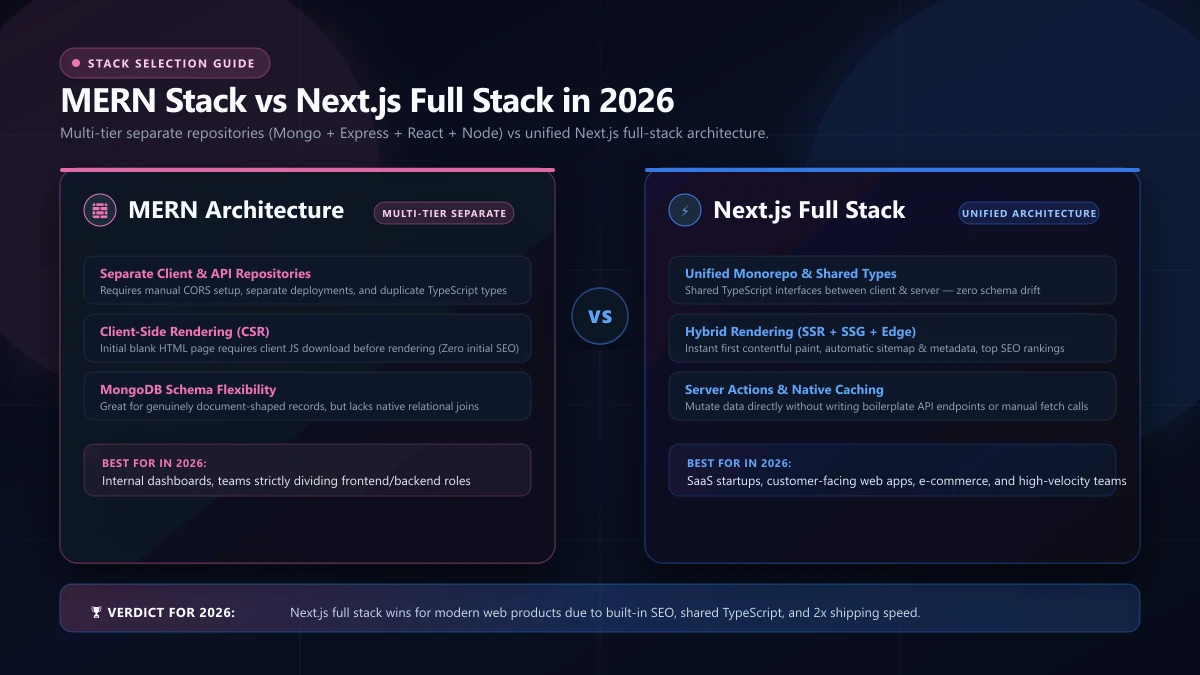
"MERN" is a stack of choices, and people pair the parts freely. The essential commitments are: a document database (MongoDB) as the primary store, an Express-flavored Node API layer, and a React SPA frontend. The "N" has always been the least controversial part — every serious JS product runs some Node somewhere.
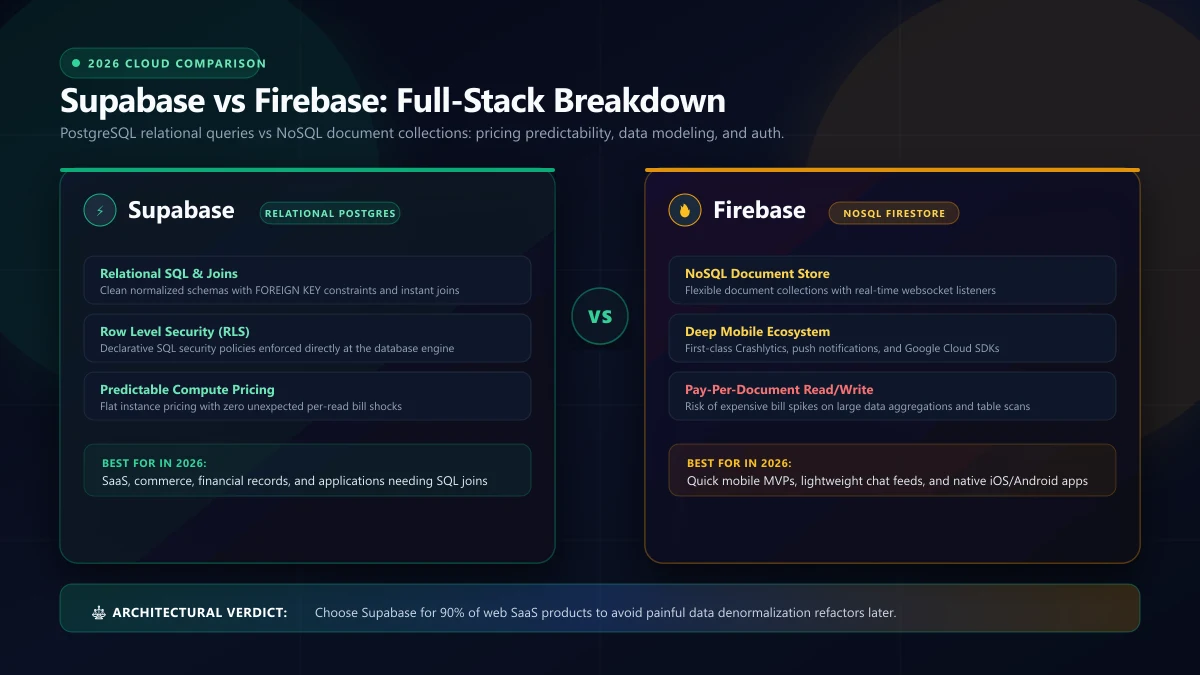
"Next.js full stack" commits differently: Next.js (App Router) for rendering plus routing plus server-side logic, with a relational database — PostgreSQL, often via Supabase — and TypeScript shared between the layers. It keeps Node; what it changes is rendering default and data shape.
Both are legitimate. Neither is legacy. Each optimizes a different set of product promises, and the honest picking question is which promises your product actually makes.
Where MERN genuinely still wins
The document shape and the fast-iteration loop are real advantages when the conditions match:
- Internal tools and CRUD-heavy dashboards where SEO does not exist (everything behind a login) and requirements change weekly. Denormalized documents absorb requirement churn without migration ceremonies; a schema-flex data model is genuinely the right tool for a spec that refuses to hold still.
- Document-shaped entities: user profiles, settings blobs, CMS content, survey responses — self-contained nests where the relations are lighter than the documents. When a record is mostly "one thing with details," documents read better, perform better, and think better than normalized tables.
- Hiring depth and familiarity. The MEAN/MERN generation of developers is enormous; there is a documented tutorial for every conceivable error, and junior engineers become productive in it in weeks. For a client project handed to a rotating team, that hiring pool matters — I inherited exactly such a project and was productive on day one precisely because the patterns are so widely documented.
- Migration tolerance. When a product's schema is genuinely unknown at launch — say an MVP where the domain itself is being discovered — schema-flex is a real benefit, not a cop-out. You pay for it at reporting time, but you also do not spend weeks re-modeling data your customers taught you was wrong.
Notice what this list does not include: anything requiring rigorous relational integrity, complex reporting, heavy multi-entity transactions, or public visibility. That omission is the whole argument.
Where the Next.js full stack wins — and usually decisively
Anything public
The moment strangers discover your product through a search engine or a shared link, Next.js's rendering architecture does work a SPA cannot amortize away: server-rendered HTML for crawlers, streaming first paint, metadata as code, sitemaps and structured data generated from the same source as the content. Retrofitting SEO onto a SPA is possible and I have done it — it is weeks of subtle engineering and a permanent tax of discipline. Born-SEO, it is the path of least resistance. My own portfolio's history — SPA first, App Router after — is a personal case study in exactly this transition.
Data with integrity requirements
Money, inventory, subscriptions, schedules, multi-tenant permissions — the moment your product makes promises to more than one entity at a time, you want relational integrity: foreign keys that refuse orphans, transactions that complete atomically, constraints that make invalid states unrepresentable. MongoDB can build most of this in application code with discipline and vigilance — I have done it — but "rely on every future developer to remember the invariant" is a much softer guarantee than "the database refuses it." My Tillqorin POS case study exists almost entirely as an argument for this paragraph: the inventory and ledger logic there is safe because the database enforces it, not because the codebase remembers.
Reporting
The first stakeholder who asks "actually, can we see orders grouped by customer this quarter?" meets the MERN/SQL divergence in real time. In Postgres that question is one query; in a document store it is an aggregation pipeline followed by application-side merging — or an additional reporting system, which is the direction most teams eventually take. I go deeper on the NoSQL-vs-SQL decision here; the punchline is that reports are not an edge case, they are the lifecycle.
TypeScript sharing, honestly assessed
The Next.js configuration's quiet superpower is one language across rendering, API, and — via generated types — the database itself. The type of an order flows from schema to API to UI without a translation layer. In MERN the layers drift: schemas defined in Mongoose, conformed in the API, re-implemented in React props, and reconciled manually. Each drift is small; together they are the Joel-test line you fail every sprint.
TypeScript, hiring, and exchange rates
Writing types once and enforcing them everywhere is cheaper than writing them three times and agreeing on them by convention. It is also the cheapest way to keep a growing team from re-litigating the same misunderstandings weekly. I use it everywhere; the question is only how much friction each stack makes it.
The decision matrix, honestly compressed
| Marketing site / blog / storefront | Next.js + Postgres. SEO is the product. |
| SaaS with billing, reporting, roles | Next.js + Postgres. Integrity is not optional. |
| Internal dashboard, admin CRUD | Either. MERN iterates fastest; Next.js wins if it must share a codebase with public pages. |
| Real-time feature-dominant product | Socket.IO/Node core; framework is a shell — see my real-time article. |
| Semantic search / AI features | Postgres ecosystem (pgvector), increasingly decisive on its own. |
| Content discovered by feeds, heavy aggregates | Relational, almost every time once reporting enters scope. |
The migration question — which stack are you rescuing?
Both directions happen in the field, and the reasons are enlightening:
- MERN → Postgres: usually reporting, integrity, or AI-vector needs. The migration is a schema modeling exercise plus the rips-and-tears of replacing client-side joins with SQL — an honest multi-week project, and worth budgeting as its own milestone (my Firestore-to-Postgres notes in the Supabase article carry over directly).
- Next.js SPA-side → MERN: much rarer, almost always some variant of "the team changed or the product retreated from public discovery." Less common because the forces run one-way: products grow public surfaces, not shrink them.
The meta-lesson: pick stacks for the product's five-year shape, not its five-week shape. Frameworks migrate in weeks; data shapes migrate in quarters, and usually forever.
What I actually build with
Public products: Next.js 16 + PostgreSQL/Supabase — Tillqorin POS and AuditBloc both live there, with the SEO and integrity arguments doing the heavy lifting. When a client's data is genuinely document-shaped and the work is internal, Express + React + MongoDB patterns remain my honest recommendation, and I do not apologize for the inconsistency — the stack follows the data, not the trend, and that sentence is the whole difference between a framework religion and an engineering practice.
FAQ
Is MERN outdated in 2026? No — it is specialized. It lost the default-position argument for public products but remains an excellent fit for internal tools and document-shaped domains. Tools do not go obsolete; they go niche.
Can I start with MERN and migrate later? You can, and many do. The honest cost accounting: migration later is a project, not a refactor. If your product has even a public surface or an accounting figure anywhere, starting relational is cheaper on the whole.
Next.js vs plain React + Express for a SaaS? For anything with a public surface, marketing pages, docs, checkout — the unified stack wins on consistency and SEO for free. For pure authenticated dashboards, either builds the same product; pick per team familiarity.
MongoDB versus PostgreSQL for a POS/inventory app? Relational, without hesitation. Transactions across stock, ledger, and orders with constraints made that build reliable in ways that would have required gymnastics in a document store.
Where does Rails/Django/Laravel fit into this debate? They are in the same room as Next.js+Postgres for most of the decision — relational integrity plus batteries-included frameworks. Language preference and hiring shape that branch far more than architecture does; the data-shape arguments of this article apply unchanged.
Performance and cost profiles compared — where the money goes
Beyond architecture, the two stacks differ in how they spend and save your two scarcest resources: engineering time and infrastructure money. The comparison matters most in month twelve, not week one, so here it is in operational terms:
- Compute shape. Next.js apps lean on edge/static delivery, which means traffic spikes mostly cost CDN money — cheap and elastic. MERN apps concentrate load on long-running Node servers with database connections held in memory — scaling means more instances, which is fine, and connection-pool discipline becomes part of the ops narrative. Neither is expensive by default; both become expensive when the load profile does not match the design.
- Database spend shape. Postgres scales vertically with indexes and replicas, and reads stay cheap — pay for capacity, not per-query. MongoDB Atlas bills the same way, to be fair; the divergence appears in query patterns — aggregate-heavy workloads on Postgres stay one-query-cheap, while equivalent Mongo aggregations at scale usually grew my clients' tier faster than any projection suggested.
- Latency economics for public pages. The Next.js/CDN combo serves cached HTML from edge nodes — the TTFB story is mostly solved by the deployment model. The SPA-plus-API combo ships the shell from CDN and then pays a data round-trip for every first interaction — the user-perceived gap on 3G phones is the real cost of that architecture, and it shows up directly in conversion curves on commerce pages.
- Developer-hour economics. The unified Next stack removes API contract work, client-side caching layers, and the auth-handoff glue that MERN teams write themselves and maintain forever. In my project logs this is where most "we saved a sprint" moments actually occurred — not in clever framework features but in work that simply did not need doing.
Team size and process implications nobody puts in the comparison
Stack choice shapes the day-to-day process conversation in ways that only show up after the first hire and the first handoff:
- One-sentence onboarding vs two-sentence onboarding. On a Next codebase, the answer to "where does this feature live?" is one sentence: "the route folder." On MERN, it is two: "the route is in Express, the screen is in React, the types live in three places, and the contract between them is this document here, which may be current." Multiplied across dozens of features, that difference determines whether a new hire's first month produces PRs or questions.
- Review surface. Next.js PRs review end-to-end — data, rendering, UI in one diff. MERN diffs split across repos or layers, and reviewers effectively review the seam between them, which is where deadline pressure encourages trust instead of verification. I have watched more contract-drift bugs originate at MERN seams than in any single layer.
- Release cadence. The unified stack deploys the whole product atomically — frontend and API can never disagree about a schema change mid-deploy. Split stacks run drift windows between deploys; the mitigation is contract tests and deploy orchestration, both real ongoing work.
None of this makes MERN wrong — small teams shipping internal tools happily run split stacks for a decade. It makes the split-stack tax real, and it puts the tax's price inside the comparison, where most blog posts forget it.
MERN vs Next.js vs the newcomers — the honest market position
The 2026 landscape has more than two players claiming the default spot, and honest positioning puts each in its place:
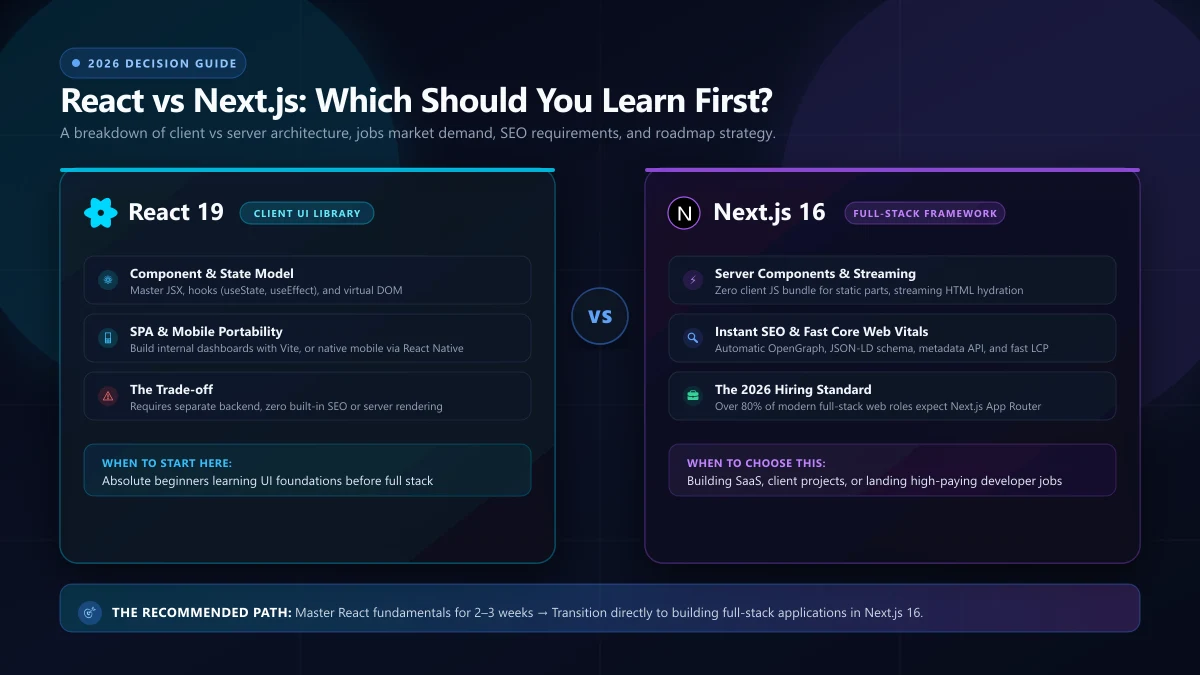
- Remix / React Router 7 and friends — excellent rendering designs from the same architectural family. If your team already runs one comfortably, there is no reason to migrate; if you are choosing cold, Next.js's ecosystem depth (docs, hiring pool, edge features, search answers) still favors it, and that ecosystem argument gets stronger every year.
- TanStack Start, Solid, SvelteKit, Astro — each genuinely good at its priority (fine-grained reactivity, content-first, islands). They change the flavor of the trade-offs above, not the fundamental decision: document store vs relational, public surface vs authenticated shell. The data-shape arguments of this article survive every framework change.
- Headless CMS + Next.js patterns for content-heavy products — increasingly the fastest route to a great public site, with the same database-partner question (content store separate from relational system of record) applying unchanged.
The durable takeaway across all of them: frameworks arrive and sharpen, but data shape and distribution surface decide the architecture, and those two questions are answerable with a whiteboard in an afternoon regardless of what ships this season.
The five questions I ask before recommending either stack
When a team brings me a stack decision, the interview I conduct takes about an hour and settles most cases. The five questions, in the order I ask them, since each one narrows the space:
- "Who finds this product — and how?" Any real search/social/sales discovery motion pushes toward the server-rendered stack. "We will grow via word-of-mouth behind a login" keeps the SPA option alive legitimately.
- "What must the data never get wrong?" Money, stock, legal entitlement, permissions — integrity requirements shortlist relational storage, which usually settles the stack by consequence.
- "Who reports on this in six months?" A named human (operations, finance, founder) becomes the SQL argument in person form.
- "What is the team's next two hires' profile?" Contract rotation vs permanent squad changes the weight of familiarity and hiring-pool arguments.
- "What does exit look like — realistically, not aspirationally?" If the honest answer is "we will still be here in five years on this stack," either answer passes. If pivots are likely, portability gets real weight.
Answers convert to scores in my head rather than on a spreadsheet, but the pattern has been consistent across dozens of consults: the data questions (2 and 3) decide most cases, and the team questions (4 and 5) refine the edges. A team that cannot answer question 2 precisely is not ready to choose a database — and that finding, on its own, is worth the hour.
Choosing a stack for your product or need architecture applied to your codebase? See my services or get a second opinion — I do these reviews regularly, and they usually pay for themselves before the meeting ends.