Somewhere around problem number 700, I noticed something odd about how I was reviewing code I had written months earlier. I was reading other people's code — a contractor's PR on a client project — and instead of reading it linearly I was skimming for shape: where was the loop nested in a loop, where did the state change, which paths could double. Nothing about that skill is on any LeetCode problem statement. It accumulated silently underneath the problem-solving, the same way forearms thicken from hauling groceries rather than from curling competitions.
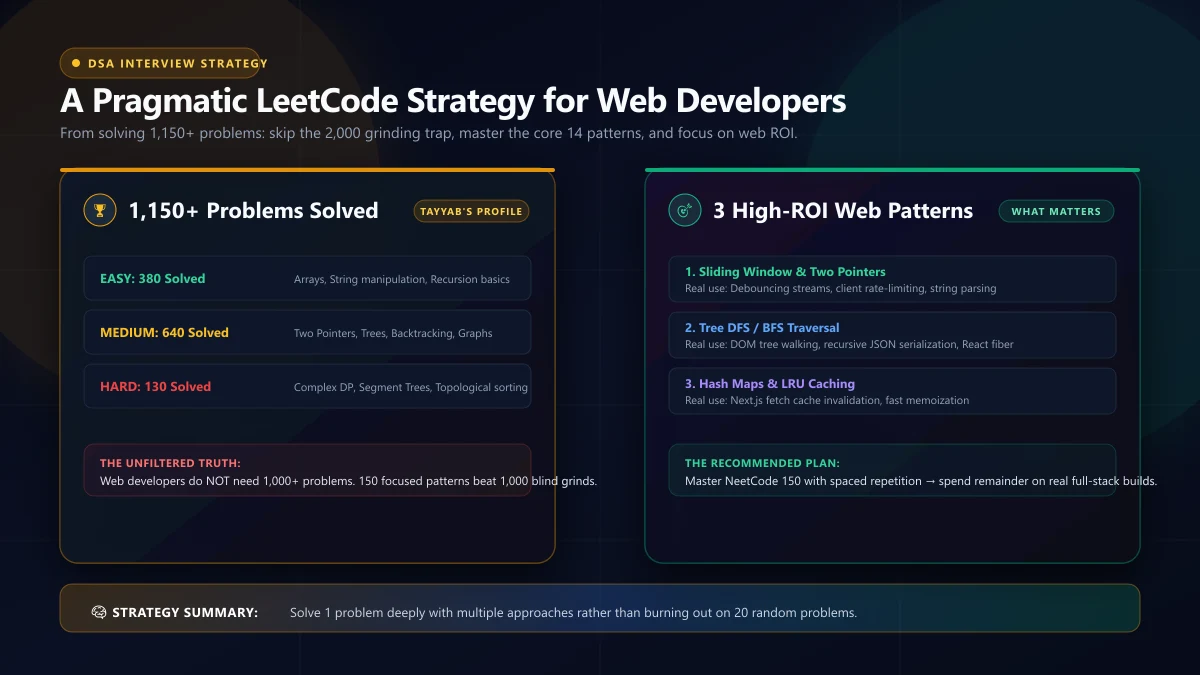
I have now crossed 1,150 problems on LeetCode, almost all in C++, alongside a residential practice of building and maintaining production web products. This article is the version of advice I wish someone had given me at problem one — including the parts that contradict the standard interview-prep gospel, because a lot of what is written about LeetCode is optimized to make you feel busy rather than to make you stronger, and feeling busy is expensive when you have a job and shipped products to build.
Why any working web developer should bother (and where the practice pays off)
The honest accounting starts with where DSA practice actually surfaces in full stack work — because if the only benefit were passing interviews, the honest recommendation would be "grind six weeks before interviews, then stop." It does more than that:
- Debugging speed. A slow report that takes a front-end team three days of "is it the API?" often takes an algorithmic thinker twenty minutes, because the question becomes precise immediately: what is the complexity of the data access path, and which loop grows with what? Binary search as an instinct — "can I bisect this state to find where the behavior changed?" — is not taught on any framework course, and it comes directly from practice.
- Data modeling instincts. Choosing between a list, a map, a set, and a heap is 80% of frontend performance in any non-trivial UI. The frameworks never teach it; the problems teach it.
- Complexity honesty in design reviews. When someone proposes an O(n²) filter client-side over 50,000 rows, you want the second-guess reflex to fire before it hits production. Algorithmic practice installs it.
- Interviews, yes. The market still asks, and pretending it does not is bad advice. But this is the smallest of the four, and the practice the other three earn you lasts a career while interview prep expires.
What it does not do, and I want this said plainly before anyone builds their identity around it: solving problems will not teach you to ship. Schema design, authentication flows, deployment realities, saying no to features, and the entire craft of finishing software is a separate education. My portfolio and my profile tell the same story only when read together, and the DSA practice was deliberately built as seasoning — not as the meal.
The patterns that actually come up — the honest core list
Solving "1,150 problems" sounds like memorizing 1,150 solutions. That is not what happens, and it is why the grind is actually much smaller than advertised: the problems recycle maybe fifteen distinct ideas across hundreds disguises. The working list, ordered roughly by how often each appears in real product engineering and interviews:
- Hash maps and sets. Deduplication, grouping, counting, memoization. Same techniques drive React key selection, cache invalidation, and database indexing decisions in spirit. If you can deeply reason about a map's cost profile, you have half the field.
- Two pointers and sliding window. Pagination, merging streams, finding ranges in sorted data. Appears constantly in real work — any "compare two sorted lists" feature is this pattern wearing a product costume.
- Recursion and trees. Component trees, file systems, org charts, parsed JSON — nesting is everywhere in our field. Understanding recursion as "trust smaller versions of the problem" rather than as function-call trivia is what separates fluent engineers from productive ones.
- Graphs: traversal, BFS/DFS, cycle detection. Build systems, dependency resolution, state machines, spreads, permission graphs. Anyway real — learn BFS and DFS by heart plus topological sort, and most product-level graph questions become accessible.
- Dynamic programming, intro level. Coin change, longest common subsequence, edit distance. The point is not to memorize DP tables — it is the reframing skill: recognizing that a lazy greedy split fails when intermediate states matter. Product code rarely needs DP; interviews and specific domains do.
- Sorting and greedy reasoning. Interval scheduling-style logic shows up in scheduling features, form validation ordering, rate limiting logic.
- Heaps and priority queues, occasionally. Top-K patterns, merging K streams. Rare in day-to-day product code; standard in interviews.
- Binary search — as an idea, not a template. Applied to answer spaces, not just arrays; this is the debugging superpower that transitioned me to skimming-for-shape which opened this article.
Everything beyond this core is specialist territory — bitmask DP, segment trees, advanced number theory. Unless a target role explicitly lives there (competitive programming, specific game/AI subfields), the opportunity cost is negative: you would spend weeks on memorization patterns rather than on the product, architecture, and communication skills your actual career compounds. The honest advice most LeetCode content dodges: the core list is worth amplifying forever; the exotic list is worth knowing exists.
The system that sustains it (because motivation is a myth)
The worst advice in this genre is "just do a problem every day," stated as if willpower were the bottleneck. The real bottleneck is design — making the sessions small enough to survive bad weeks, and structured enough to compound. System, in full:
- 30–60 minutes, fixed time, calendar-anchored. Mine was attached to the morning, before any work, because evening practice competes with a full day's fatigue and always loses for me. Pick a slot that does not require a decision to keep.
- The 20/20/20 rule. Twenty minutes of genuine attempt — writing code, not scrolling. Then, if stuck, realize it: read the solution, understand it thoroughly (trace it on paper), and schedule a re-implement from memory the next day. People who grind blind for two hours on stuck problems mostly learn anxiety; people who fail correctly learn patterns. The willingness to fail deliberately is the entire skill.
- Tag-based spaced repetition. Keep a log; re-solve problems from 3 days and 2 weeks prior with tags so themes re-appear before they assassinate you in interviews. My old system was a spreadsheet; honest, ugly, effective.
- One language, deeply, not twelve superficially. I chose C++ deliberately — it forces manual memory and complexity discipline that carries over into how I think about JS allocations and rendering costs. The specific language matters less than the depth; surface-level multilingual practice produces surface-level instincts.
- Track streaks, not problems solved. A daily habit that survived forty problems is worth more than a weekend that did two hundred. The compounding claimed by any number-obsessed tracker lies in showing up; the calendar never lies.
Language choice, honestly considered
People ask this constantly, and the truthful answer has tradeoffs:
- Python — fastest to prototype, shortest solutions, cleanest to read later. The pragmatic default for interview prep, especially timed sets.
- C++ — deepest performance intuition, closest to "what is the machine actually doing." My choice, and the reason my cost-sensitivity in production code is what it is. Steeper curve; worth it if you can take the punishment.
- JavaScript/TypeScript — lowest friction for a web developer and zero context-switching. Weaker at low-level reasoning; perfectly serviceable for 90% of problems.
Whatever you pick, pick it and stop auditioning languages. Interviewers care whether your reasoning is sound; nobody has ever failed a loop for using Python's dict instead of C++'s unordered_map.
If you have eight weeks and one impending interview
Compressed schedule, tuned for the most common goal — a working developer with one target company and no time.
- Weeks 1–2: arrays, strings, hash maps — 5-6 problems per pattern until recognition is instant.
- Week 3: two pointers + sliding window.
- Weeks 4–5: trees and recursion, then graphs (BFS/DFS/topological sort).
- Week 6: DP intro (climb stairs, coin change, house robber, LCS) — recognition over derivation.
- Week 7: timed mixed sets, random tags, mock-interview format.
- Week 8: behavioral logistics plus the company's real interview style — because underprepared delivery ruins prepared algorithms every time.
Enough to interview credibly. The system then shrinks to maintenance mode: two or three problems a week, kept indefinitely, because the debugging instincts that started this article are the compounding payoff, not a sprint phase.
FAQ
"1,150 problems — do I need that many?" No. The number reflects years of a habit I kept because it branches into everything above. For credible interviewing, 150–250 well-chosen problems across the core patterns is the honest scope.
"Do web developers really get asked LeetCode?" Frontend-leaning roles ask lighter versions (arrays, strings, DOM reasoning); full stack and product engineering roles ask LeetCode-style recursions and graphs with real frequency. Interview difficulty correlates with the company's hiring process maturity more than with day-to-day difficulty of the work.
"Is grinding LeetCode good for learning to code at all?" Only as one ingredient. It builds reasoning and fluency; it does not teach architecture, commerce, or shipping. Balance it with real projects or it becomes an avoidance behavior disguised as discipline — a trap the interview-prep industry profits from.
"Premium subscriptions — worth it?" The company-tag features help during an active hunt. The core education does not need them; the free problem bank plus a personal tag log covers the entire path named above.
"What if I have a CS degree and found interviews easy anyway?" Then lean into the other three benefits — debugging instincts, data modeling, cost honesty — which stay useful daily regardless of how pleasant interviews were. My degree friends who stopped at interview-easy plateaued in exactly those three places.
Studying without burning out — the long-game version
Every algorithm-practice guide eventually confronts the same wall: six weeks into the grind, the sessions get shorter, the skipped days multiply, and the person quietly quits without ever deciding to. I went through that wall twice before I understood what it actually is — not a discipline failure, but a design failure. A practice that only runs on motivation is a project with a hidden dependency on your mood, and mood is the least reliable infrastructure you own. The long game is built differently:
- Halve the daily minimum during bad weeks. A 20-minute session that happens beats a 60-minute plan that doesn't. The compounding effect of the practice lives in the streak, and the streak survives bad weeks when the bar legitimately lowers. Actually writing the lower bar down — "bad-week mode: one easy problem, 15 minutes" — removes both the decision and the guilt.
- Rotate subjects before boredom sets in. A week of graphs, then a week of dynamic programming, then strings, keeps the material fresh. Note-boredom is a signal to rotate, not to quit — pattern recognition needs variety the way physical training does.
- Attach the practice to curiosity when possible. The weeks I made real progress were the ones where a work problem led me to a topic — an inventory race at the day job somehow made graph-coloring interesting for the first time. Chase those bridges intentionally; the practice becomes self-sustaining when it keeps explaining the work.
- Log honestly, celebrate closes. A simple log of date/pattern/minutes-outcome beats any fancy tracker. The habit that survives is the one with a visible history; streak-shame is just tracker vanity, and vanity makes a terrible coach.
The honest expectation-setting: over a year of steady practice at modest volume, most people solve a few hundred problems and — far more importantly — change how they read code and fallacies. The 250-problem engineer with steady habits out-interviews the 900-problem cram-cycle engineer almost every time, because pattern recognition trained over years beats pattern trivia memorized over months.
From LeetCode to system design — the natural next chapter
There is a misleading fork in the interview-prep world between "DSA prep" and "system design prep," as if they were different careers. In practice they are the same skill at two scales, and algorithmic instincts transfer upward in specific, concrete ways worth spelling out for anyone interviewing at senior levels:
- Complexity thinking becomes capacity planning. The instinct that knows a nested loop multiplies cost knows that a fan-out notification service multiplies write load — same reasoning, different unit. My Tillqorin reporting indices were designed with exactly the analysis that binary-search intuition trains.
- Analyzing trade-offs becomes architecture taste. A person who can argue hashing-vs-tree on paper argues queue-vs-synchronous, batch-vs-stream, cache-invalidation strategy on real products. The habit of naming trade-offs explicitly, and writing down the values being traded, comes from problems and pays rent in design reviews.
- Failure-mode imagination becomes reliability thinking. Interview problems train you to ask "what input breaks this?"; system design asks "what traffic breaks this?" The habit of enumerating failure first, features second, is what senior reviews reward — and I read it directly off interview candidates' DSA fluency in ways resume lines never predict.
Concretely, if you have the DSA core and are prepping for design rounds: pick three systems you genuinely use and write one page on each — data model, read/write paths, failure points, scaling levers. One page of real reasoning beats three hours of watching architecture diagrams about systems you have never operated, and interviewers can tell their stories apart without difficulty.
A week in the practice, written down honestly
Abstract systems convince nobody at midnight, so here is what my actual week tends to look like when life is normal — copy it, edit it, break it into your own shape:
- Monday–Thursday, 40 minutes before work: one main problem from the current pattern, then — nearly always the better half of the session — 10 minutes reviewing yesterday's solution as if it were someone else's PR. The reviewing habit is what converts accepted answers into transferable instinct; people who only solve tend to collect solved problems like unread bookmarks.
- Friday, shorter session: re-solve two older problems from the log without opening editor history. Awareness of what you have actually retained, versus what you remember having known, is the difference between progress and a memory illusion.
- Weekend, optional longer block: one genuinely hard problem with no timer — the unposed kind where you allow dead ends and restarts. Timed practice builds examination temperament; untimed practice builds depth. Both matter, and the weekend slot is where depth gets its share.
- Skip days happen. Travel, deadlines, family — the log records them without judgment, and the practice resumes Tuesday. The all-or-nothing devs quit by March precisely because their system treats a skipped day as a moral event rather than a data point.
That level of detail might read like overkill for "just some LeetCode." It is the opposite: the schedule is small enough to survive life and structured enough that progress is visible on a monthly graph — and visible progress is what no motivational quote can replace.
Questions about how DSA practice fits into a full stack career? Read about my work or ask directly — I answer these questions individually fairly often, and I enjoy them.